
How It Works
From a school connection
to food every weekend.
Dependable food starts with understanding the child. Here is how we connect with schools, tailor support and keep food arriving, week after week.
SCHOOL CONNECTIONS. INDIVIDUAL CARE.
How support starts
Finding where support is needed
We work with school boards, Barrie Food Bank and other community partners to identify areas where children face a high level of food insecurity. That local knowledge helps us decide which schools to approach. We grow steadily, adding schools as funding and volunteer capacity allow us to provide dependable support.
Working with the school
Once a school is identified, we meet with the principal to explain the program and how it will work together with the school. The principal works with teachers to identify children who could benefit and invite their families to participate. School staff know their students; their relationships help us reach children quietly and thoughtfully.
Getting to know each child
An intake form and a phone conversation with the parent or caregiver help us understand the child's allergies, dietary needs and food preferences, as well as delivery arrangements. We use that information to adapt our four rotating menus. Kids Pantry handles intake and ongoing family communication directly, keeping the school's administrative role small.
Starting support, then listening
Deliveries begin once intake and arrangements are in place. After four weeks, we contact the family to learn what worked for the child and what didn't. Have they enjoyed the food? Are there items they leave uneaten? That feedback helps us adjust their menu. Families can also contact us as needs or preferences change.
Participation begins through a school relationship. We add schools thoughtfully as funding and capacity grow. Schools interested in future involvement can learn more about working with Kids Pantry.
THE CARE CONTINUES
A routine children can count on
Once a child joins the program, a regular rhythm of purchasing, packing and delivery turns that commitment into weekend food.
Wednesday
Pack individual bins
Shelf-stable food chosen for each child.
Thursday
Buy fresh food
Fruit, vegetables and bread for the weekend.
Friday
Pack backpacks
Bring each child’s food together.
Friday
Deliver to children
Paired teams take the food to schools or homes.
Shelf-stable supplies are purchased in larger quantities every few weeks, ready for this weekly routine.
- Every few weeks
Stocking the shelf-stable food
We purchase shelf-stable food every few weeks, planning around the rotating menus and the children we support. Keeping those supplies on hand gives the packing team what it needs for the weeks ahead. Fresh food is purchased separately each week.
- Wednesday
Filling individual bins
Volunteers pack shelf-stable food into an individual bin for each child. The four-week menu rotation gives us a starting point, but each bin reflects that child's dietary needs and preferences. Each selection stays together in its own bin, ready for Friday.
- Thursday
Shopping for fresh food
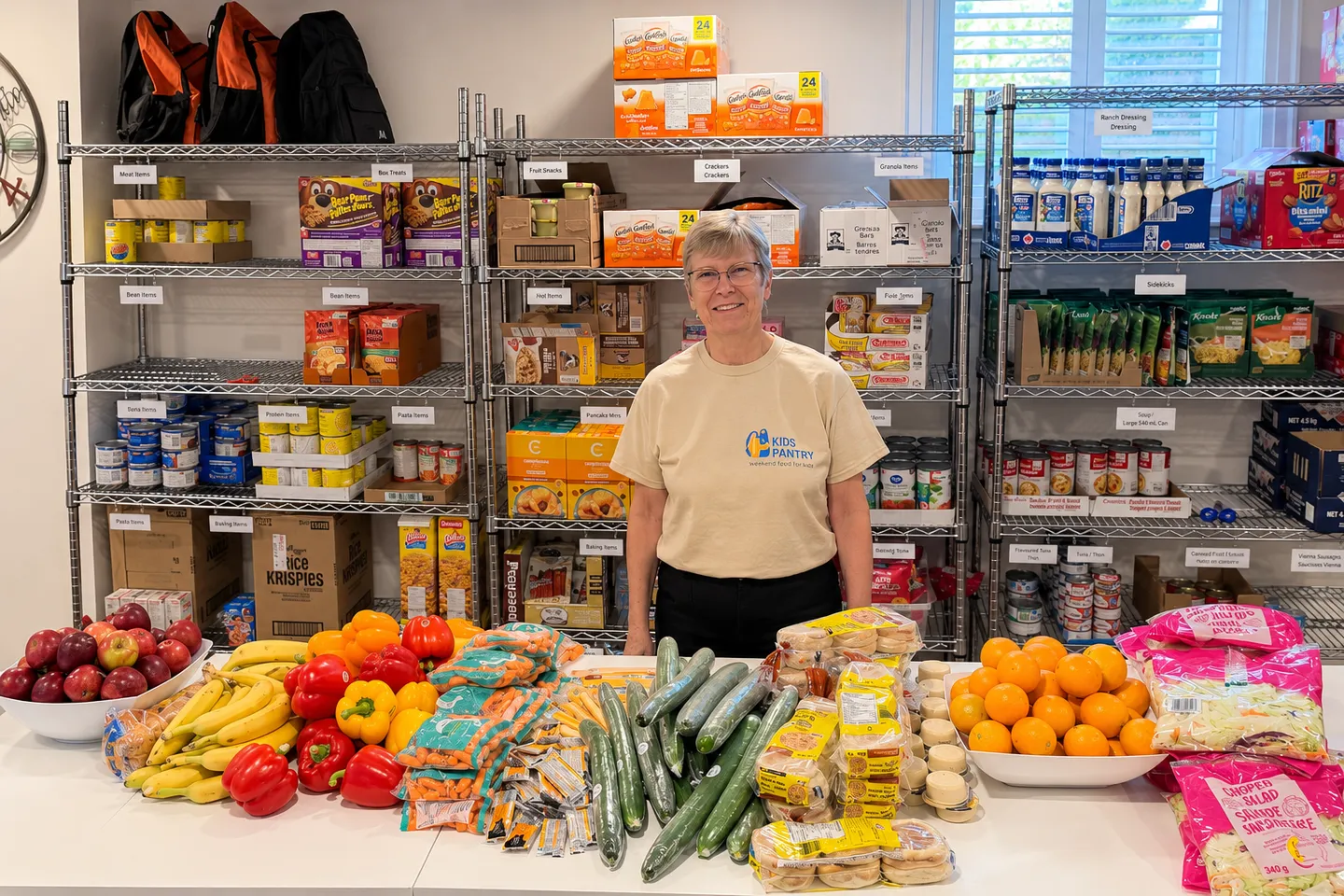
We purchase the fresh fruit, vegetables and breads for that weekend. Buying fresh food every week complements the shelf-stable items already set aside and brings variety to the meals and snacks each child receives.
- Friday · Packing
Bringing the weekend together
Volunteers bring the fresh food together with each child's shelf-stable selection. During the school year, the food goes into ordinary backpacks in a mix of colours and designs. In summer, we use paper bags. Each child's food is intended to cover eight meals and two snacks, from Friday dinner through Monday breakfast.
- Friday · Delivery
Getting food to each child
Delivery teams travel in pairs of volunteers. They drive to the school, drop off the backpacks and check which participating children are absent. The team then delivers those children’s food to their homes, so missing school does not mean missing weekend support. Backpacks are collected the following week, cleaned and reused.
School is out. Support continues.
Fresh food and weekend support continue 52 weeks a year. During school holidays and summer, we deliver to homes rather than relying on school pickup. The route and packaging may change; the commitment to the child continues.
We also consider other children in the household, including younger and high-school siblings, with grocery-card support where appropriate. There is no cost to participating families or schools.